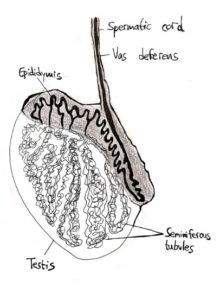
The testes begin to develop around the fifth week of pregnancy, and by birth have undergone a process known as testicular descent, where they move to their final location in the scrotum. This movement is essential for spermatogenesis post-puberty, as the scrotal temperature is lower than in the abdomen and allows for sperm to develop.
Cryptorchidism is a condition occurring in 2-4% of infant males, where either one or both of the testes are undescended at birth. Cryptorchidism will usually be detected by a doctor during a routine examination. Sometimes, an undescended testis will spontaneously correct itself during infancy. If not, the condition can usually be surgically corrected. If left undescended, the unfriendly abdominal temperatures will result in the inability to produce sperm and complete infertility.
The corrective surgery of the condition, known as orchiopexy, will usually take place within the first year of the baby’s life. During orchiopexy, the undescended testis is moved into the scrotum. In some cases, the doctor may recommend hormonal treatment as well. While usually successful and leading to the normal production of sperm, an initially undescended testis has been shown to be a risk factor for infertility. The reasons for this, though unclear, may be damage to the testis caused by the abdominal temperatures prior to surgery, or by an anti-sperm immune response triggered in the abdomen.